Updates tailored to you.
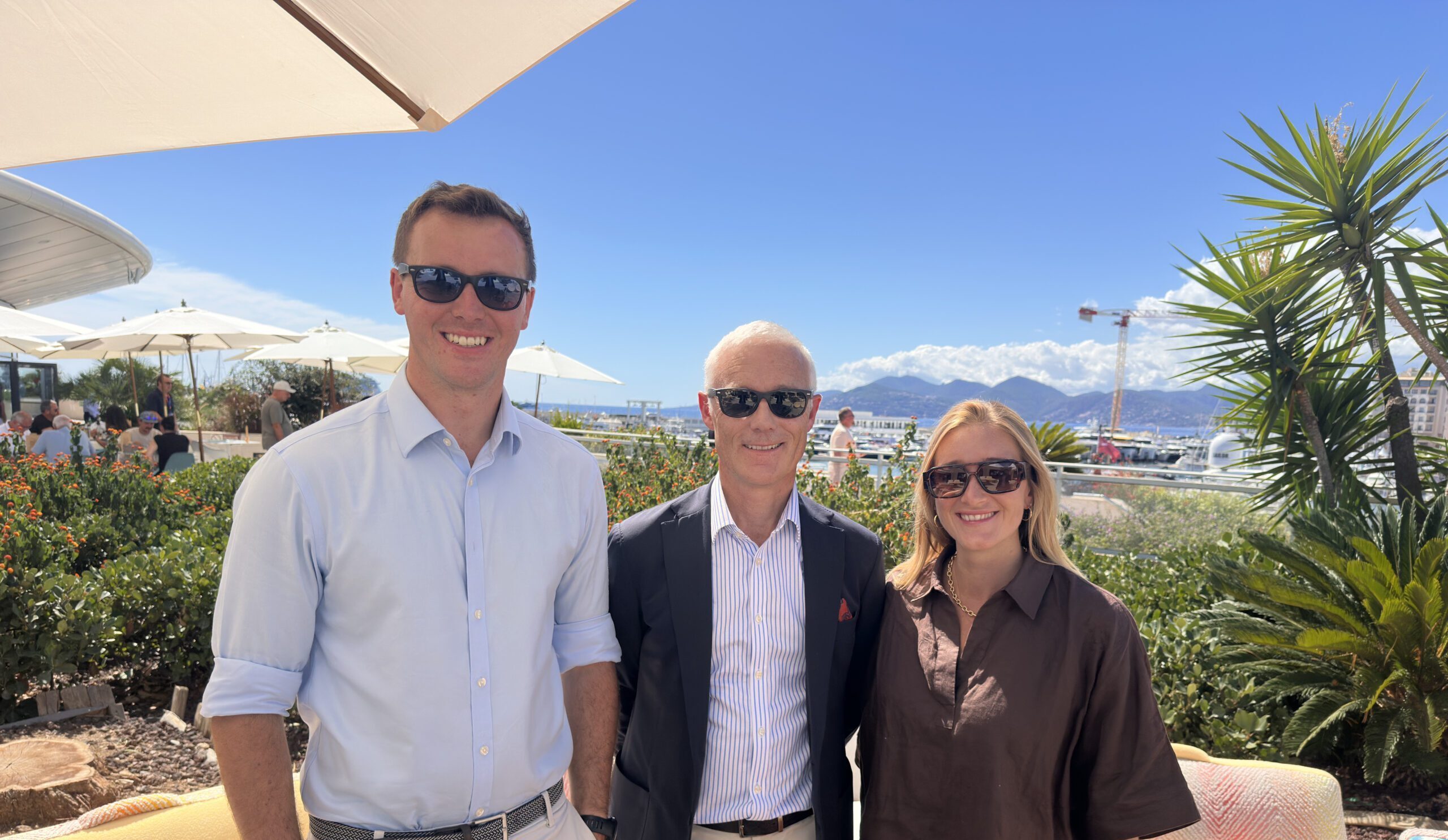

Before yacht builders were designing tender garages around Williams boats, Mat Hornsby and his brother John were building wooden boats in their parents’ garden.
The workshop was in rural Oxfordshire. Their father used it for woodwork, and the brothers grew up learning to make things, with access to tools Mat now suspects they were allowed to use a little too young.
They went to university to study different subjects. Back at home, they were working on their first boat. “I always say the best businesses start in garden sheds,” Mat says.
Speaking at the Cannes Yachting Festival for Series Two of the Founder Podcast, the Williams Jet Tenders co-founder looked back on a journey stretching roughly three decades: years of financial uncertainty, a change of direction, an engine discovered in a newspaper and relationships that helped turn a small family venture into an internationally recognised brand.
Ten years of finding a way
The brothers spent around ten years building two or three wooden boats, selling them and trying to finance the next step. At one point, funding the business meant remortgaging their parents’ home.
Money was scarce. They knew they could build a beautiful boat, but craftsmanship alone had yet to give them a sustainable business. What it did give them was something worth showing people.
Ahead of attending the London Boat Show at Earls Court in 2003, Mat wrote handwritten letters to three senior figures in British boatbuilding, including Sunseeker’s Robert Braithwaite and Princess’s David King.
The message was straightforward: they were two young men who had built a wooden boat, and they would love them to come and look. All three came.
For Mat and John, being noticed by people whose businesses they admired was a powerful encouragement. It also established a principle Mat returns to throughout the interview: progress often depends on getting in front of the right people.
The attention did not immediately solve their financial problems, but it showed that the quality of their work could earn a hearing.
Finding a market that could move faster
Eventually, the brothers recognised that wooden boats were unlikely to deliver the volume they needed, so they began exploring yacht tenders, developing a fibreglass prototype around an engine sourced from South Carolina.
The new product found buyers. They started supplying Fairline and Sealine, with tenders offered as part of the yacht package. Within roughly two years, Mat recalls, they were building around 100 boats a year from the family garden workshop.
“We knew we’d found a niche and a corner of the market that was active and that was looking for something different.”
That demand gave them a reason to keep developing the product. The next challenge was finding better propulsion technology. The answer appeared in an unexpected place: the motoring pages of the Sunday Times.
The newspaper discovery that changed the business
An article about an amphibious car caught Mat’s attention. It used a German-built four-stroke engine that he thought could work in their tenders. The following day, he made a call to the founder: “Can we come over and see you?”
The engine supplier believed in what the brothers were trying to do and provided engines for development. Mat describes finding the right engine as a pivotal moment.
It gave them the foundation for a product they believed could offer a better experience than the existing two-stroke jet tenders. However, they still needed money to bring it properly to market.
Roy Parker, a boat owner and product designer, understood the opportunity. He owned a Fairline Squadron 58 with a two-stroke tender and knew the clouds of smoke that accompanied starting it in a marina. The improvement the brothers were proposing was tangible to him.
He joined the business before it was officially registered in 2004, bringing investment and design experience. For Mat, that combination marked the beginning of the next phase of Williams’ growth.
The freedom of having something to prove
Looking back, Mat describes that early period as one of the most exciting stages of building a company. The brothers believed their product had an advantage, and they could make decisions quickly and move faster than larger competitors.
There was little organisational structure to slow them down, although there was also little financial security. “You’re free,” he says. “You can make decisions really quickly and you can be disruptive.”
Investment gave them the stability to act on that confidence, and it also meant finally moving out of the garden.
They found commercial premises near a test lake, an important requirement for a boatbuilder. The building felt so large that they initially partitioned it and sublet the rear to limit the cost. Within six months, demand meant the wall had to come down. The space they had worried about filling was already needed for production.
Growth brought its own financial demands: orders required engines, materials and the cash to build boats before the business could realise the return. Finding a market was one milestone, but funding the capacity to serve it was another.
The partnership that began on a go-kart track
Mat’s commercial role meant travelling to meet yacht builders and persuade them to look at the product. At the Genoa Boat Show, he approached people in the Italian industry without an established reputation to rely on.
“Look, you don’t know me, but here’s what we do.”
One conversation with a founder of Pershing led to an invitation to a dealer event in Slovenia. He found himself in a go-kart race with the man whose support he hoped to win. He remembers deciding that, however competitive he felt, this was probably a race he should let the other driver finish first.
The relationship developed into a contract to fit Williams tenders into the Pershing range. That helped open the wider Italian market.
For founders wondering how to get started when nobody knows them, Mat’s advice is direct: “Grow the confidence and grow the ability to speak to anybody and be humble about what you do.”
The relationship he is proudest of
Through the financial pressure, expansion and years of decision-making, Mat and John have continued working together. Mat leads the commercial side, whilst John heads technical development.
“We’re just best mates,” Mat says.
The division of responsibilities matters, but the trust underneath it matters more. They know what each has put into the business and what they have risked along the way. For Mat, that relationship carries more weight than status or financial success.
“I’m prouder of that than a lot of things that we’ve done.”
He recognises that family businesses do not always work. His experience rests on a willingness to put the relationship ahead of ego and money.
It is a revealing measure of success from someone discussing an internationally established boat brand: maintaining the partnership with his brother is among the achievements he values most.
Becoming the tender customers ask for
The company’s relationships with yacht builders now begin much earlier than a conversation about supplying a boat. Mat describes Williams being involved at the engineering stage, with garages designed around its tenders.
“We’re only as good as the retail customer demanding our product.”
Owners need to want a Williams, and yacht builders need confidence in the quality, fit and support available after delivery.
At the time of the interview, Mat cited a network of around 50 dealers supporting customers worldwide. Together, customer demand and service coverage make it easier for builders to specify the product.
The relationship has grown with the yacht manufacturers themselves. As their boats have become larger, Williams has developed bigger tenders to serve them.
That evolution also helped create the opportunity for a second brand.
Why Evene needed its own identity
Evene Tenders launched in 2025 and sits alongside Williams Jet Tenders within Williams Marine Group. Mat explains that the separate brand allows the group to explore a different part of the production superyacht market while drawing on its existing manufacturing capability and supply chain.
The rigid boats, without inflatable tubes, also create a clear distinction from the core Williams offering.
A separate identity gives the team room to consider different designs and, potentially, propulsion choices without confusing customers about what Williams Jet Tenders represents.
“Freedom is one part of it,” Mat says. “And identity is another part.”
The challenge is building recognition for a new name. The advantage is doing so with decades of experience behind it.
Still arriving with the cleaning kit
Mat says he never expected the business to reach its present scale. At its post-pandemic peak, he recalls production exceeding 1,200 boats a year. By Cannes, he described a tougher market and a return towards more sustainable levels of demand.
His response is to keep investing in product development, both for the larger yacht sector and ahead of a recovery in smaller boats.
“We just want to be five years ahead of anybody.”
The processes that come with scale (departments, staffing and spreadsheets) are necessary, but the product remains the part that draws him back.
At shows, he still arrives before opening with a cleaning kit, joins the team preparing the boats and looks carefully at what competitors are doing.
It is a detail that connects the established company to its beginnings.
The workshop has become a manufacturing business. The handwritten introductions have become long-term industry relationships. But Mat still wants to look closely at the boat, see what could be better and make sure it is ready for the person who walks up next.
Mat Hornsby was interviewed as part of Series Two of the Founder Podcast, a collaboration between the Ben Taylor Podcast, Yachting Ventures and Marine Industry News, filmed at the Cannes Yachting Festival in 2026.