Updates tailored to you.

Early-stage fundraising in marine hardware is rarely straightforward. Capital requirements are high, timelines are long, and many investors struggle to underwrite risk in markets they don’t fully understand.
In a recent Yachting Ventures fireside chat, the team behind ENVGO shared a candid breakdown of how they approached fundraising — from leveraging prior founder experience to structuring a 12-month raise that resulted in a $1.5M round.
The conversation offered a useful reminder: successful fundraising is less about pitching harder, and more about preparation, positioning, and patience.
ENVGO was founded in 2021 by a team with deep roots in the drone industry. Crucially, this wasn’t a newly assembled founding group — the core team had already worked together for more than a decade, including through previous startup journeys and exits.
That history mattered.
At the pre-seed stage, ENVGO was able to raise around $2M in 2022 — significantly higher than the $500k–$750k range typical for first-time founders in hardware.
Investors weren’t just backing an idea; they were backing a team with proven execution dynamics and shared history under pressure.
For early-stage founders, this reinforced an important point: team narrative is often as important as product narrative. Investors are underwriting people long before they’re underwriting scale.
Rather than rushing into the market, ENVGO treated fundraising as a long-term process.
The team planned a 12-month runway:
They began with a broad universe of around 600 potential investors, which was then narrowed to a focused target list of roughly 150. These weren’t generic angels — they were investors with appetite for hardware, deep tech, and long time horizons.
Warm introductions were central to this strategy. Existing investors and founders in the team’s network helped open doors, and early conversations were treated as relationship-building exercises rather than immediate pitches.
The goal wasn’t speed. It was alignment.
One of the most valuable insights from the session was how ENVGO adapted its story depending on who was in the room.
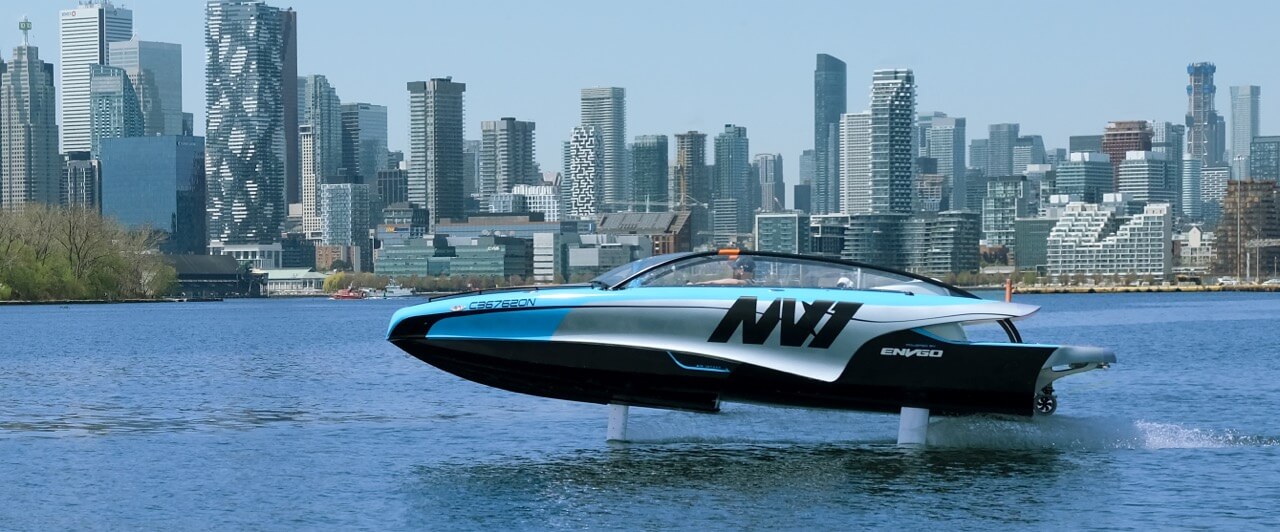
At its core, ENVGO is developing electric hydrofoiling boats — but it’s also building a broader technology platform with applications beyond a single vessel.
Some investors were excited by the boat itself: performance, efficiency, and the immediate product. Others were more interested in the long-term platform opportunity: software, data, and scalable technology layers.
Rather than forcing a single narrative, ENVGO treated storytelling as modular. The fundamentals stayed the same, but emphasis shifted depending on investor background, interests, and familiarity with boating.
This flexibility proved especially effective with angel investors, where personal connection and intuition often matter as much as spreadsheets.
Market sizing is a common stumbling block in marine tech, where clean data is often limited.
ENVGO approached this by combining top-down and bottom-up analysis. On the top-down side, they referenced the roughly $20B North American boat market.
Bottom-up, they started with a more modest initial opportunity — around a $50M boat business.
From there, the story expanded.
As conversations evolved, ENVGO worked closely with its lead investor to articulate how the company could grow into a $500M+ technology platform, and ultimately support a multi-billion-dollar long-term vision.
Where hard data was lacking, they supplemented with:
One powerful dynamic ENVGO benefited from was investor–customer overlap.
Some of the most aligned investors were people who could easily imagine themselves as future customers — boat owners, technology enthusiasts, or operators with first-hand experience of the problems ENVGO was solving.
In several cases, early adopters came directly through the investor network. That feedback loop strengthened conviction on both sides: investors could self-validate demand, and ENVGO gained real-world insight early.
Non-dilutive funding also played a role. Government grants and other programmes helped extend runway and de-risk development — reinforcing the company’s credibility during equity discussions.
Several best practices emerged clearly from ENVGO’s experience:
Perhaps most importantly, fundraising was treated as a process of mutual selection — not persuasion at any cost.
These sessions come from inside the Yachting Ventures community — where founders get direct access to operator-led masterclasses, fireside chats with industry insiders, and practical education you won’t find in public webinars.
👉 Apply to join the community here to access our full programme of educational events, recordings, and founder-only discussions.