Updates tailored to you.

The Yachting Ventures Startup Spotlight series goes beyond the pitch decks and press releases to share the real stories behind early-stage startups.
We sit down with founders in our community to explore their journeys, from the first spark of an idea to the realities of building a company in leisure marine.
This week, we sat down with Samantha Broughton, founder of dorah.
I was at sea for 15 years, part of the early evolution of the modern superyacht industry, and I’ve since spent even longer working inside new builds, refits and residential projects as an interior consultant within owner teams.
My work as an interior consultant, ranges across operational reviews and studies, owner supply, and full interior set-ups.
Across projects, I kept noticing something consistent: beautiful designs, intelligent teams and an enormous amount of information flowing through different tools.
Presentations would sit in PDFs. Procurement in a spreadsheet. Links to products in whatsapp, emails. Discussions on whatsapp. Inventory documented elsewhere.
Every tool serves its purpose well. But the story of the interior, the connected narrative from concept to operation, wasn’t being held in one place.
That’s where I saw an opportunity. One client said to me, “I just want to see the project all at once.”
Not buried in PDFs sitting in email threads. Not reliant on meetings or calls where information fades over time. That was the gap.
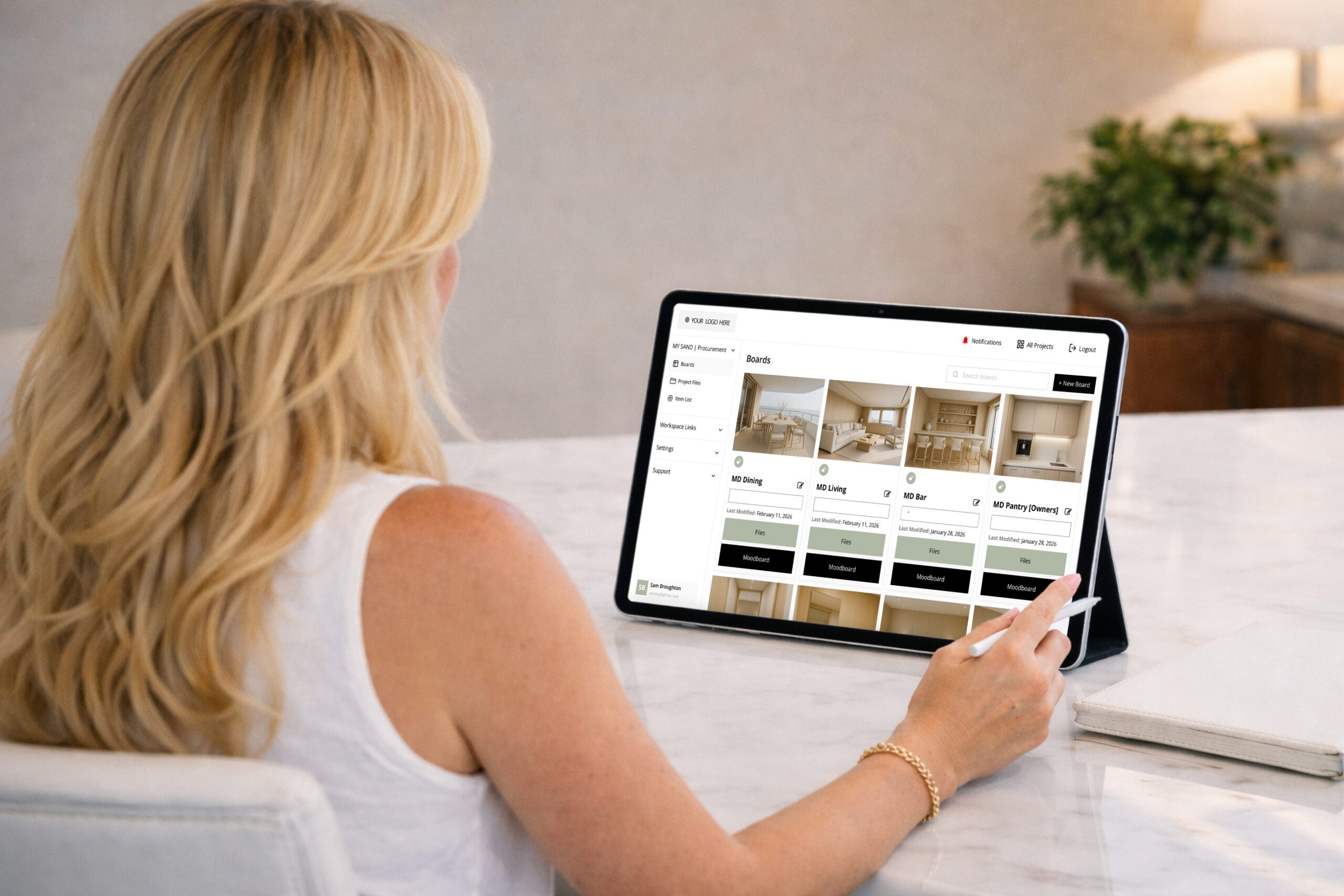
Dorah began as a tool I built for my own consultancy work at Superyacht Interior Studio. I needed one structured, visual workspace that could hold the full story, moodboards, links, notes, procurement lists, inventory and conversations, in a way that made sense to designers, crew and especially owners.
Dorah is a place where the entire interior can live in one structured environment, always presentation ready, always contextual.
At any moment, you can open it and see the yacht interior from a bird’s eye view. Clean. Organised. Complete.
Not pieced together. Not reconstructed. Just clarity. Over time, I realised this wasn’t just my frustration.
Superyacht interiors are complex operational systems that need to function at sea, under pressure, across seasons and through ownership transitions. Retaining information is essential.
If you ask at the beginning of a project, “How are you going to approach this? or Where will you hold information for stakeholders?” The answer is usually a stack of tools.
Design software. Spreadsheets/Pdfs. Cloud storage. Messaging platforms. Presentation software. Talented people moving between them, assembling context as needed. It works.
The industry consistently delivers at an exceptional standard. But it depends on individuals continually reconstructing the full picture.
Dorah doesn’t replace existing systems. It introduces a structured interior layer, one place where the visual thinking, the commercial decisions and the operational detail sit together coherently.
Instead of information being reassembled for each conversation, the narrative is already held.
Design intent remains visible. Decisions are traceable. Context travels with the project. It doesn’t automate expertise. It supports it.
By holding the interior story in one organised environment, Dorah reduces reliance on memory, preserves continuity across transitions and creates clean, presentation ready moments when they’re needed.
I think that kind of clarity strengthens delivery quietly and consistently.
I’ve really enjoyed building something that genuinely makes a difference, especially in a world where people are already carrying so much cognitive load. I’ve always been operationally wired. I like structure. I like anticipating friction before it happens.
What I didn’t expect was how satisfying it would be to see others feel the benefit of it.
When someone opens Dorah and pauses, not because it’s complicated, but because it’s clear, that moment matters. One early user said, “This makes me feel calm.” That, for me, was the benchmark.
There’s something deeply rewarding about creating a tool that supports talented people without asking for attention. Not loud. Not showy. Just useful.
Building Dorah has also stretched me. You’re not just designing a product, you’re designing resilience, patience and belief. You learn to hold the long view. You refine. You listen. You improve.
But above all, I am enjoying building something that supports the industry I’ve grown up in, in a way that feels thoughtful and considered.
Superyachting is built on experience, trust and relationships. Projects are delivered at an extraordinary standard. So when something new is introduced, the natural questions are, “Why do we need it?” and “Why should we care?”
Those are fair questions. Early on, the challenge wasn’t technical. It was cultural.
Dorah asks teams to think about holding context more deliberately, to structure information from the outset rather than assembling it later. To consider how an owner might want to visualise the yacht at any moment, without preparation.
That shift from reactive compilation to proactive clarity, requires explanation, support and time.
There’s also the discipline of building something simple.
When designing software, the temptation is to add features quickly. Complexity is easy. Restraint is harder. Holding the line on clarity, keeping the interface calm and resisting unnecessary expansion has been a conscious decision.
You can learn how to use Dorah in minutes. Achieving that level of simplicity was one of the most demanding parts of building it.
Those early challenges shaped the product. They forced it to be intentional, considered and genuinely useful rather than reactive.
I see Dorah becoming a popular interior layer within the superyacht ecosystem, we have already had amazing feedback.
The goal isn’t rapid expansion for its own sake. It’s considered adoption. Dorah is already being used across new builds, refits and operational yachts in a way that feels natural, something teams turn to because it’s simple and really supports them, not because they’re required to.
I hope it will continue to support more Interior designers, Interior consultants and New Build steward/ess at concept stage, and continuing to support the operational interior long after delivery, preserving context as the yacht moves from shipyard to sea.
Technically, we will continue refining integrations and capability. But philosophically, the focus remains the same: simplicity, clarity and longevity.
If you can open Dorah and feel immediate orientation, if an owner can see their yacht clearly at any point, then we’ve elevated the experience for everyone involved.
Growth matters. Relevance matters more.
Building something meaningful takes resilience. It isn’t romantic. It isn’t one breakthrough moment.
It’s very late nights, difficult decisions and a level of commitment you didn’t know you were capable of. You discover your capacity and then you learn to stretch beyond it. And just when you think you’ve reached your limit, you realise there’s more. That’s been the most surprising part. Not the milestones. The expansion of yourself. It’s continuing when momentum dips.
It’s refining when you’re tired. It’s holding belief before there’s evidence.
And it takes longer than you think. Be prepared to iterate. Be prepared to listen. Be prepared to stay with it longer than feels comfortable.
Above all, build something that genuinely makes someone’s day smoother. Just go for it and feel free to call me anytime! Support is essential.
Look for the alignment and view things from other perspectives. I tend to think in terms of the long game. If something works for everyone involved, it usually stands the test of time. I love a win–win.