Updates tailored to you.
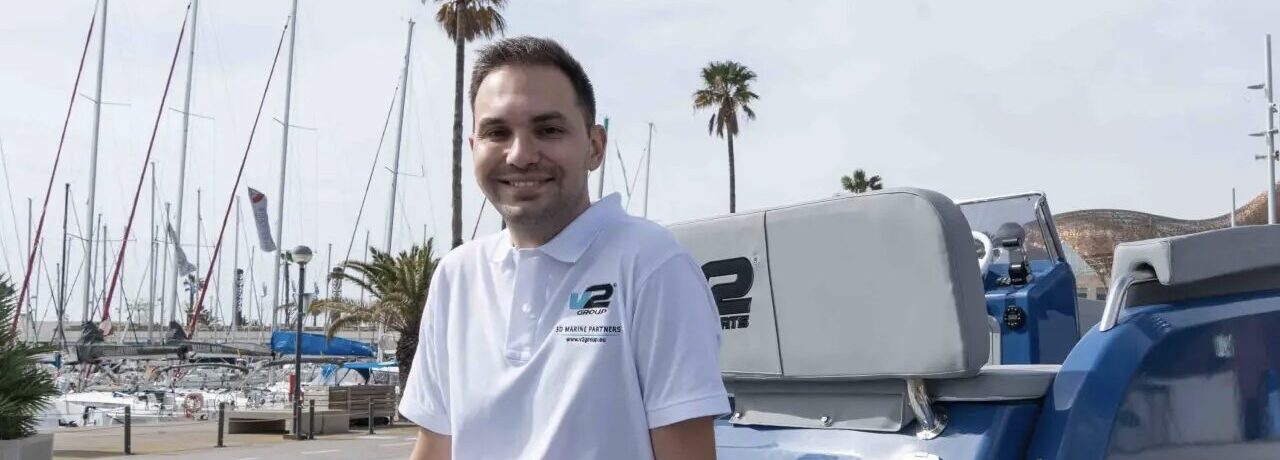

This week, we put the startup spotlight on Albert Chamarro from V2 Group, a Spanish tech startup pioneering large-format 3D printing nautical solutions that designs and manufactures boats and marine components, specialising in sustainable and customisable solutions including Europe’s first monolithic 3D-printed catamaran.
What’s your story? How did you come up with the idea for your business?
After years of experience in the nautical sector, the founders identified a specific market need: the demand for customised structures and components. To address this opportunity, the idea of applying large-format additive manufacturing (LFAM) was born. This led to the creation of V2, with the goal of becoming a strategic partner in large-format 3D printing for the nautical industry.
Why does the industry need the solution you’re providing?
In a market that increasingly demands personalisation and where achieving economies of scale is becoming challenging, large-format additive manufacturing stands out as the ideal solution. This technology enables the creation of fully customised structures with complete cost control. Moreover, the materials we use allow us to tackle the critical challenge of sustainability and recyclability, aligning with current industry demands.
What have you enjoyed most about starting your own company?
Starting a business in the nautical sector is a dream come true, as it means turning my passion into my profession. Adding technological development makes it the perfect project for me.
Read more: B-Craft to debut luxury tender at Venice Boat Show
What challenges did you have to overcome at the beginning?
One of the biggest challenges we faced early on was understanding Large Format Additive Manufacturing (LFAM) technology and translating that knowledge into a functional MVP. Working with LFAM is incredibly complex, demanding a deep understanding of materials, mechanical behaviour, and digital fabrication processes.
Our MVP was a 6-meter catamaran printed entirely using LFAM, a bold prototype that pushed us to the limits with significant structural and performance challenges that forced us to iterate rapidly for over a year. Now that we’ve matured, technology is no longer our primary hurdle.
The real challenge today lies in building a solid business foundation and developing strategic partnerships in the nautical sector — a transition from being purely technology-driven to becoming market-driven.
What’s next for your business? Where do you see it in 3–5 years?
Our vision is to position V2 as the leading technological partner in Large Format Additive Manufacturing (LFAM) for the nautical industry in Europe. We believe LFAM has the potential to revolutionize how boats and marine components are designed and built.
This is a bold goal that demands technical excellence, strong commercial strategy, and continuous innovation, but we’re confident in our team of engineers, designers, and entrepreneurs.
In 3 to 5 years, we see V2 as a key enabler of innovation in marine manufacturing, creating ecosystems where digital design, additive manufacturing, and sustainability converge to offer groundbreaking solutions and becoming the go-to partner for companies exploring new frontiers in naval architecture.
Any advice for entrepreneurs just starting out in this space?
Investing time and resources in the product area is essential. Having a strong CTO with both technical and strategic vision makes a significant difference. And above all, patience is key. As we operate in an industry with extremely high structural standards, doing things right is not optional, but absolutely critical.
And a fun one—what’s a quote or some words that you live by?
There’s a Spanish saying I often repeat during tough phases: ‘Manolete, Manolete, if you didn’t know, why did you get involved?’ It’s a reminder — half humorous, half fatalistic — that this path demands commitment, clarity, and the willingness to face complexity head-on.
For more Startup Spotlights, click here.